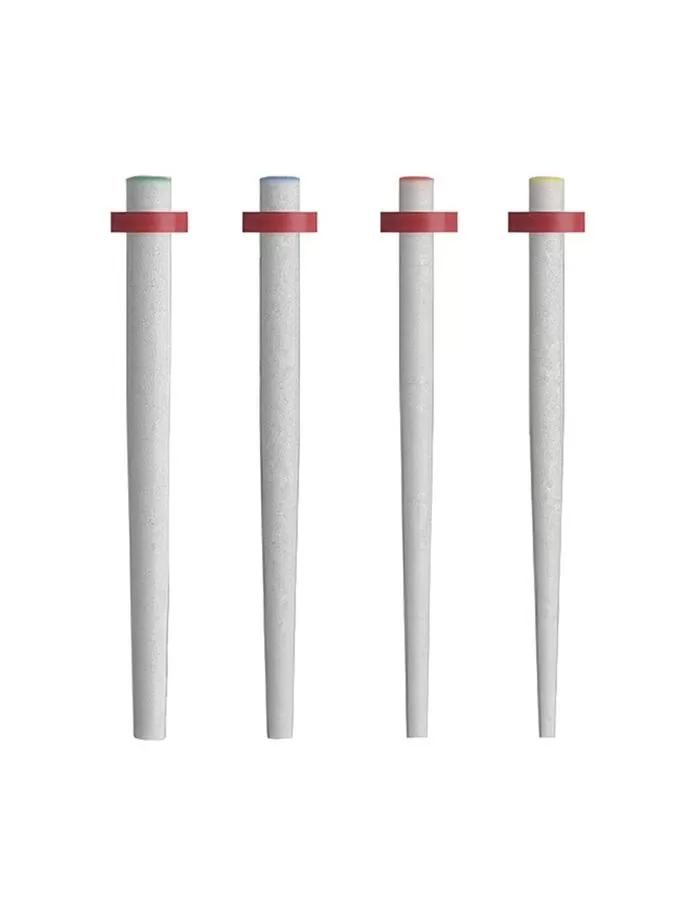
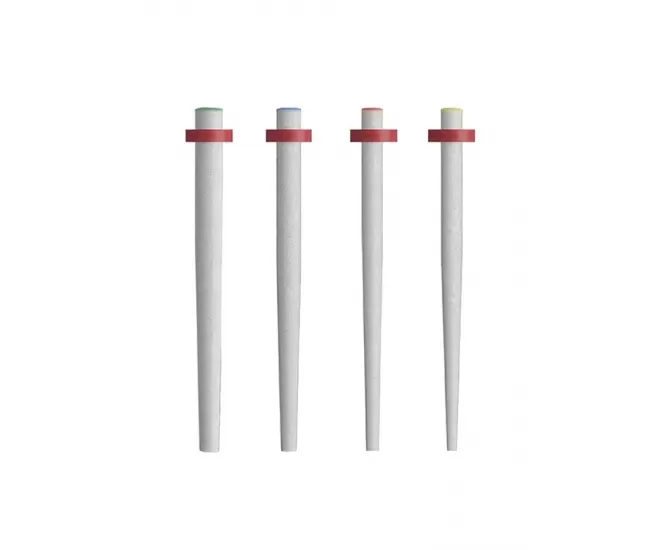
DirectFit silanized glass fiber posts
35.00€
Product Code: 071001
Manufacturer: FKG Dentaire Sarl
Country: Switzerland
Description
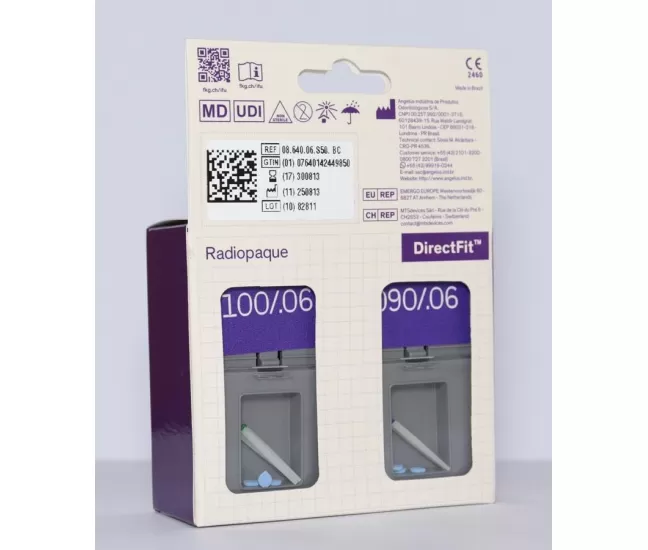
FKG DirectFit™ – Radiopaque Glass Fiber PostsFKG DirectFit™ are radiopaque, factory-silanized glass fiber posts specifically developed for the restoration of endodontically treated teeth. Designed according to the principles of minimally invasive dentistry, DirectFit™ provides a simplified, conservative approach to post placement while helping preserve natural dentin and remaining tooth structure.
The main advantage of DirectFit™ is its ability to fit directly into root canals prepared with 0.04 or 0.06 constant-taper rotary endodontic instruments, without requiring additional post space drilling. The space created by the final shaping file is used for post placement, eliminating unnecessary dentin removal and supporting a precise, predictable fit.
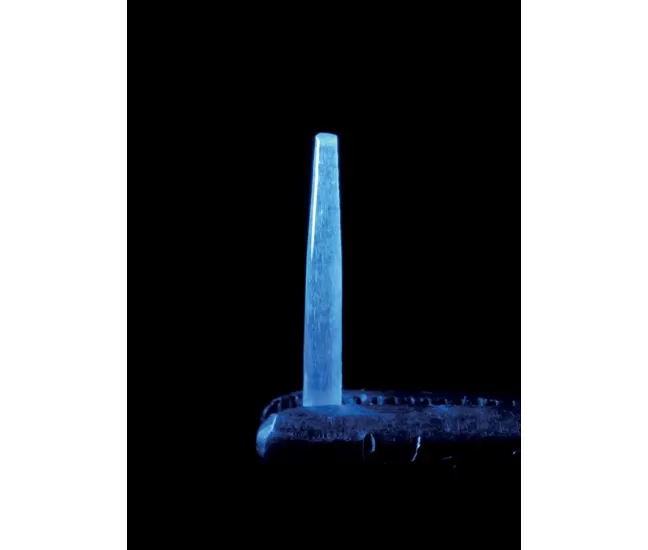
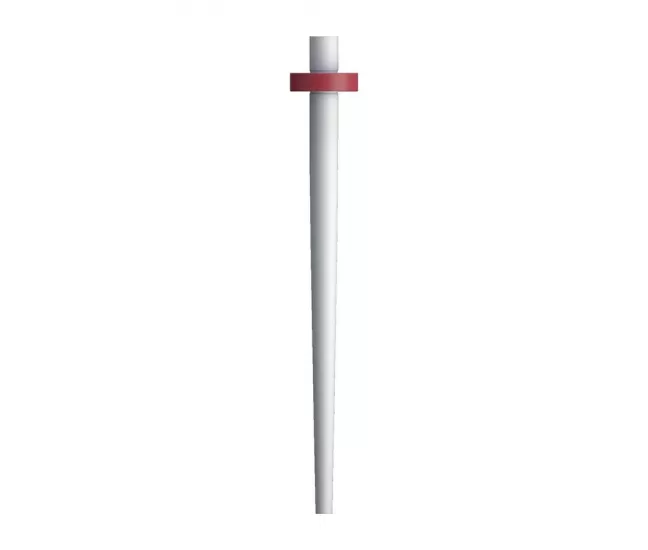
Manufactured from zirconia-enriched glass fibers, DirectFit™ posts combine high flexural strength, dentin-like elasticity, excellent radiopacity, and translucent optical properties. Each post is factory-silanized to enhance adhesive bonding with resin-based materials, supporting reliable cementation and durable restorative results.
Key Features and Benefits
Simplified Post Placement Procedure
DirectFit™ is specifically designed to match root canals prepared with 0.04 or 0.06 constant-taper rotary files. This provides a predictable fit without the need for additional drilling or special post space preparation instruments.
The space created by the final shaping file becomes the post space. After removing the desired amount of gutta-percha, the root canal is ready for post placement.
This simplified approach reduces the number of preparation steps, streamlines the clinical workflow, and supports efficient restorative procedures.
Minimally Invasive Restoration
DirectFit™ follows a minimally invasive approach by helping preserve remaining dentin and natural tooth structure.
Unlike conventional post systems that may require additional canal enlargement, DirectFit™ posts are designed to fit the space already created during endodontic canal shaping.
Since no additional dentin needs to be removed to create a post space, the remaining tooth structure is preserved, supporting a conservative restoration approach.
Factory-Silanized Surface for Enhanced Adhesive Bonding
Each DirectFit™ post undergoes factory silanization to improve adhesive bonding with resin-based restorative materials.
The silanized surface promotes chemical and micromechanical bonding with dual-cure and light-cure resins, helping achieve reliable adhesion between the fiber post, cement, and restorative material.
The optimized post surface enhances cement adhesion, supporting a strong and stable post-restoration interface.
High Flexural Strength and Mechanical Resistance
DirectFit™ glass fiber posts are engineered to withstand the mechanical stresses associated with everyday use.
Their high flexural strength contributes to the mechanical durability of the restoration, while the optimized fiber-to-resin ratio provides increased resistance to functional loading.
The homogeneous internal structure and uniform distribution of glass fibers help maintain consistent mechanical performance throughout the post.
Dentin-Like Elasticity
DirectFit™ posts feature an elastic modulus close to that of natural dentin.
This mechanical characteristic supports the tooth's structural resilience and promotes favorable behavior under functional loading.
The combination of elasticity and high flexural strength makes DirectFit™ suitable for conservative restorative procedures following endodontic treatment.
Excellent Radiopacity for Clear Radiographic Assessment
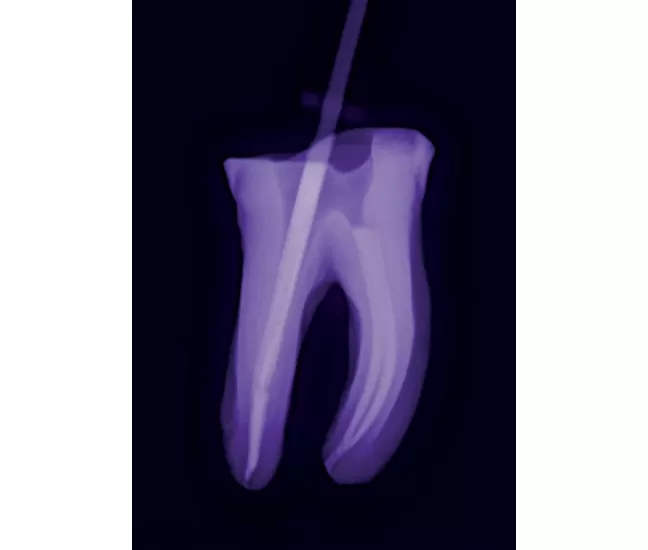
DirectFit™ posts are manufactured using a zirconia-enriched glass fiber composition that provides a high level of radiopacity.
This allows the posts to be clearly identified on postoperative dental radiographs, facilitating the evaluation of post positioning and the final restorative result.
The radiopaque composition contributes to more convenient radiographic assessment following post cementation.
Translucent Appearance for Aesthetic Restorations
DirectFit™ posts are translucent, making them particularly suitable for highly aesthetic dental restorations.
Their optical properties help maintain a natural appearance and minimize unwanted visibility of the post through restorative materials.
This makes them an appropriate solution for cases where both mechanical performance and aesthetic outcomes are important.
Uniform Glass Fiber Distribution
DirectFit™ posts feature a homogeneous cross-sectional structure with evenly distributed glass fibers.
This uniform fiber distribution contributes to consistent mechanical properties and reliable performance.
The optimized combination of glass fibers and resin provides strength and structural stability.
Simple and Clear Clinical Protocol
DirectFit™ features a straightforward clinical application protocol designed to support safe, intuitive handling.
The simplified preparation and placement process minimizes the need for additional instruments and extensive training, making the system practical for everyday restorative procedures.
Technical Specifications
Intended use: Restoration of endodontically treated teeth, post cementation, and core build-up.
Material: Zirconia-enriched glass fiber composite.
Structure: Homogeneous cross-section with uniform glass fiber distribution.
Surface treatment: Factory-silanized.
Radiopacity: 2.41 mm Al/mm post.
Flexural strength: 835.9 MPa.
Elasticity: Modulus of elasticity close to natural dentin.
Optical properties: Translucent, suitable for aesthetic restorations.
Compatible root canal tapers: 0.04 (4%) and 0.06 (6%).
Post selection: According to the size of the final root canal shaping file.
Adhesive compatibility: Supports bonding with dual-cure and light-cure resin materials.
Recommended cementation material: Self-etching, self-adhesive, dual-cure resin cement.
Additional post space drilling: Not required when the canal has been prepared with compatible rotary shaping instruments.
Clinical application: Minimally invasive restoration and conservative post placement.
Available Sizes and Configurations
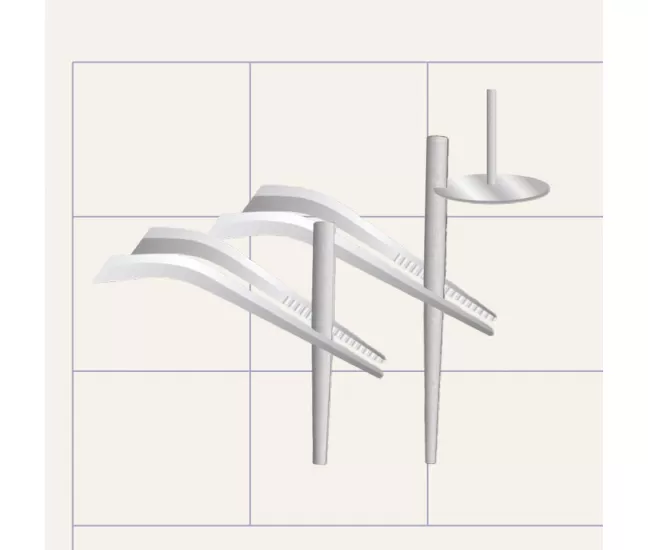
DirectFit™ glass fiber posts are available in two different taper configurations: 0.04 (4%) and 0.06 (6%).
The selection of the appropriate post depends on the dimensions and taper of the final rotary instrument used during root canal preparation.
DirectFit™ Fiber Posts – 0.04 Taper (4%)
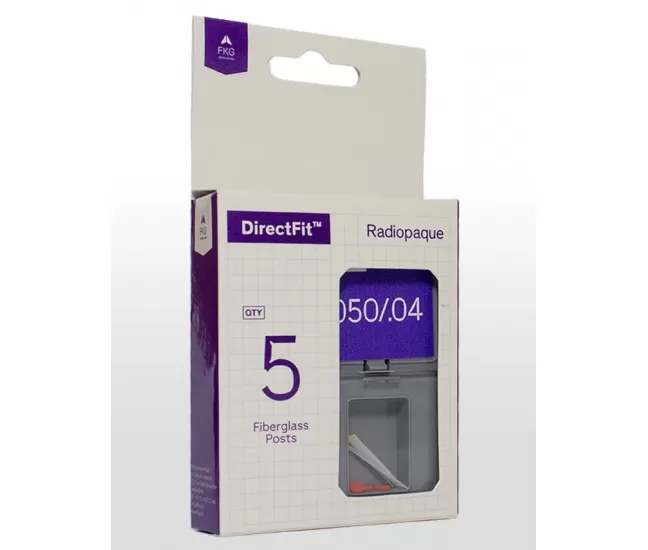
Available sizes: 050/.04, 070/.04, 090/.04, and 110/.04.
These posts are designed to match root canals prepared with 0.04 constant-taper rotary instruments.
DirectFit™ Fiber Posts – 0.06 Taper (6%)
Available sizes: 050/.06, 070/.06, 080/.06, and 100/.06.
These posts are designed to match root canals prepared with 0.06 constant-taper rotary instruments.
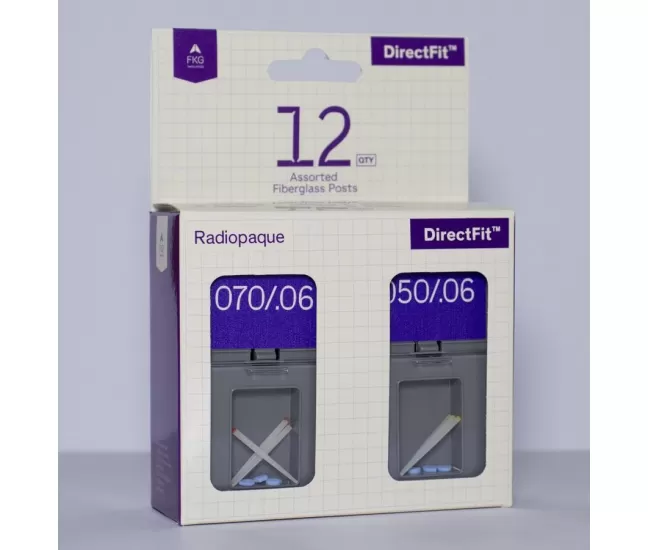
Assortment packs containing different post sizes are also available, providing flexibility when selecting the appropriate post for different clinical situations.
Clinical Application and Cementation Procedure
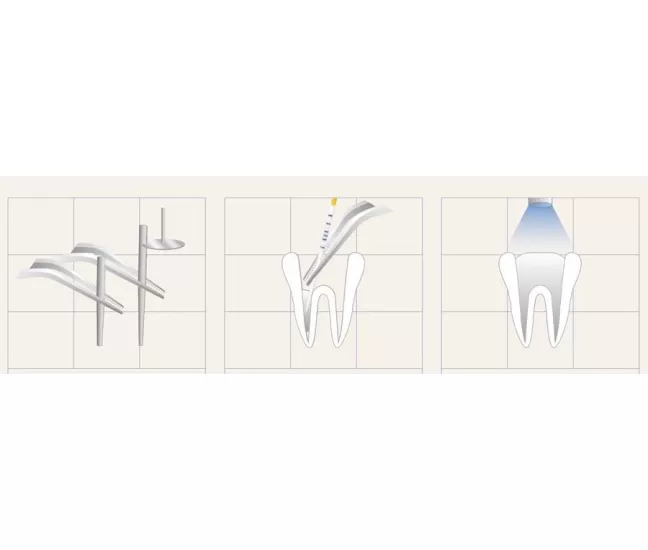
The DirectFit™ post cementation protocol consists of three main stages: post space and post preparation, tooth surface preparation, and cementation followed by core build-up.
1. Post Space and Post Preparation
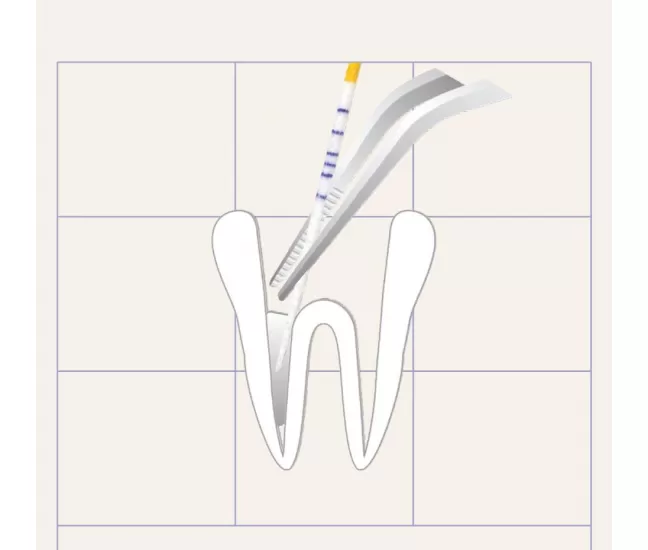
The post space is created during endodontic canal shaping using the final shaping instrument. No additional drilling is necessary.
After removing the required amount of gutta-percha, the post space is cleaned with saline solution. Cleaning may be performed using mechanical irrigation, ultrasonic techniques, or laser-assisted methods.
The appropriate DirectFit™ post is selected according to the size of the last instrument used during root canal shaping.
The post length is adjusted by cutting it approximately 2 mm short of the occlusal surface.
The post surface is then cleaned, adhesive is applied, and the post is thoroughly dried and light-cured for 10 seconds.
2. Tooth Surface Preparation
The tooth surface is prepared according to the requirements of the selected bonding system.
The manufacturer's illustrated protocol includes etching the dentin for 15 seconds, followed by thorough rinsing and drying of the root canal using paper points.
Adhesive is then applied to the canal walls and rubbed into the surface for approximately 15–20 seconds.
Any excess adhesive remaining inside the canal is removed using paper points when necessary.
The adhesive is subsequently light-cured for 10 seconds.
3. Post Cementation and Core Build-Up
A self-etching, self-adhesive, dual-cure resin cement is injected into the prepared root canal.
The DirectFit™ glass fiber post is carefully inserted into position and light-cured according to the cement manufacturer's instructions.
Following post placement, a flowable hybrid composite material is applied around the post to build up the core or direct restoration.
The composite material is light-cured for 20 seconds according to the procedure described in the brochure.
The restoration is then completed using the appropriate restorative technique.
Intended Use and Clinical Applications
FKG DirectFit™ glass fiber posts are intended for professional dental use in restorative procedures following endodontic treatment.
The system is designed to support the reconstruction of teeth requiring post placement and core build-up while minimizing unnecessary removal of remaining dentin.
DirectFit™ is particularly suitable for restorative procedures where preservation of tooth structure, predictable post fit, reliable adhesive bonding, and mechanical stability are important.
Its combination of a simplified placement protocol, factory-silanized surface, high flexural strength, dentin-like elasticity, and excellent radiopacity provides dental professionals with a practical solution for conservative restorations.
FKG DirectFit™ – preserve dentin, simplify post placement, and support long-lasting restorative results.
Package: 5 pcs.
Related Products

Glass fibre composite posts Glassix, 6 pcs.
22.00€

Cytec Calibration Drill
6.40€

Glass fibre composite posts kit Glassix Plus
240.00€

Cytec Glassfiber Posts Set
150.00€

Glass fibre composite posts Glassix Plus, 10 pcs.
77.00€

Contec Glassfiber Posts, 10 pcs.
58.00€

Glass fibre composite posts kit Glassix
105.00€

Reamer for fibre post Glassix
9.00€

Cytec Glassfiber Posts, 10 pcs.
58.00€